 A view of the "Bedell House" c. 1918 when it still sat along Hempstead Turnpike. Photo first appeared in Garden and Home Builder magazine in 1926.
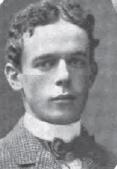 Those who are attuned to local history are familiar with the fact that West Hempstead’s oldest and most valued relic can be found at Old Bethpage Village Restoration. The Bedell House was a modest wood frame house built in the 18th Century in colonial style, and was originally located on the north side of Hempstead Turnpike just west of Mayfair Ave. By 1918, it had fallen into disrepair and was rescued by new owners, Carl L. and Lena Otto, who moved the house north toward the Garden City border. Carl L. Otto (pictured at left), a master architect who designed many prominent buildings and bridges in the Northeast, put his knowledge and expertise to work by having the house transported north toward the Garden City border and restored to its former glory. (Long time residents referred to the property surrounding house as Otto’s Woods).
The Roosevelt Savings Bank building on Gates Ave in Brooklyn (below left) and the Washington Street Bridge in Providence, RI (below, right, photo courtesy of Lisa J. Miller) are two examples of Otto's works.


In 1982, Carl's widow Lena, who was 100 years-old by then, donated the home to the Nassau County Parks Dept. who then transported the structure to Old Bethpage where, for the past 30 years, it has awaited a restoration that never happened.
But who owned the house before the Otto’s and how far back does it date to? When it was acquired by Old Bethpage, not much was known about its past and so an effort was made to puzzle together some historical information about the house. It was discovered that homestead dated to the last decade of the 18th century and was traced back to a man named Hiram K. Bedell who expanded the structure in 1835. The Bedell family was prominent throughout Long Island and Hiram’s father, Abraham, was postmaster for Hempstead Village. Beyond this, not much information was available about this home, so I decided to do see if could uncover any other clues about its history. What I discovered startled me.
A little while ago, I came into contact with a descendant of Hiram Bedell who was born and raised in West Hempstead. His grandfather, Alfred McCoun, was born in the Bedell House. (For those who wish to keep score, Hiram and Hannah Bedell had a son, Henry, who had a daughter Mary. Mary Bedell married Willett McCoun who had Alfred. Hiram Bedell died in 1870. His wife, Hannah, died at the age of 98 in 1894 and left 165 living descendants at the time of her death). He was kind enough to share with me a photo of the home of his grandfather from the 19th Century. I instantly noticed some obvious structural differences between the home in the photo and the one at Old Bethpage. This led me to discover that the house, in fact, is not the Bedell House at all, but another home that sat a couple blocks further west on the Turnpike. More importantly, the house may well be much older that previously thought, perhaps built as far back as the early 1700s! In 1926, Carl L. Otto penned an article in the Garden & Home Builder journal, detailing his transportation and renovation of the home. At the time of his purchase, Otto carefully studied some features of the home, particularly the handwrought strap-hinges, h-hinges and hand-made nails used in its construction and, in his expert opinion, concluded that it was at least 175 years-old. If true, that would date the Bedell House to around 1743, almost 50 years older than previously estimated, and would rival the Schenk farmhouse from Manhassett as the oldest house at Old Bethpage. (Some sources at the county have 1730 as the date it was built while another source claims 1765).
But who owned the house before Otto, if it wasn’t the Bedells? A notice in the April 4, 1918 edition of the Hempstead Sentinel at the time the home was originally moved gives us a clue. It was the family of John T. Hanna, a Brooklynite who worked on Wall Street as a stock broker. Hanna purchased the home in the 1870s as a summer retreat in the country for his wife and five children. At the time of his purchase, the property ran all the way back to the Garden City border and included both sides of what today is Mayfair Ave. In 1913, John Hanna died and soon thereafter the house fell into disuse before the Ottos rescued it in 1918. Who the owners of the house were before the Hanna’s still remains to be discovered. Owing to the fact that the house has been uprooted twice, and in the second move, the three chimneys supporting the structure were removed, the building is now beyond repair. It's actually amazing that the house has survived until now. The sturdy pine timbers used by the original owners (the Hannas used to refer to their retreat as "Pine Tree Cottage") have proved remarkably resilient. It has been deemed too deteriorated to warrant restoration and the decision was made to tear it down and build a replica. While the County is still busy securing funding for this project, head down to Old Bethpage and get one last look at a home that has been part of our local landscape for over 350 years.
 Above is a view of the home c. 1926, after the Otto's moved it to the WH-Garden City border and restored it.
 The "Bedell House" as it appears today at Old Bethpage.


