The following article originally appeared in the Fall 2008 edition of the West Hempstead Civic Association newsletter. The article has been updated with minor modifications.
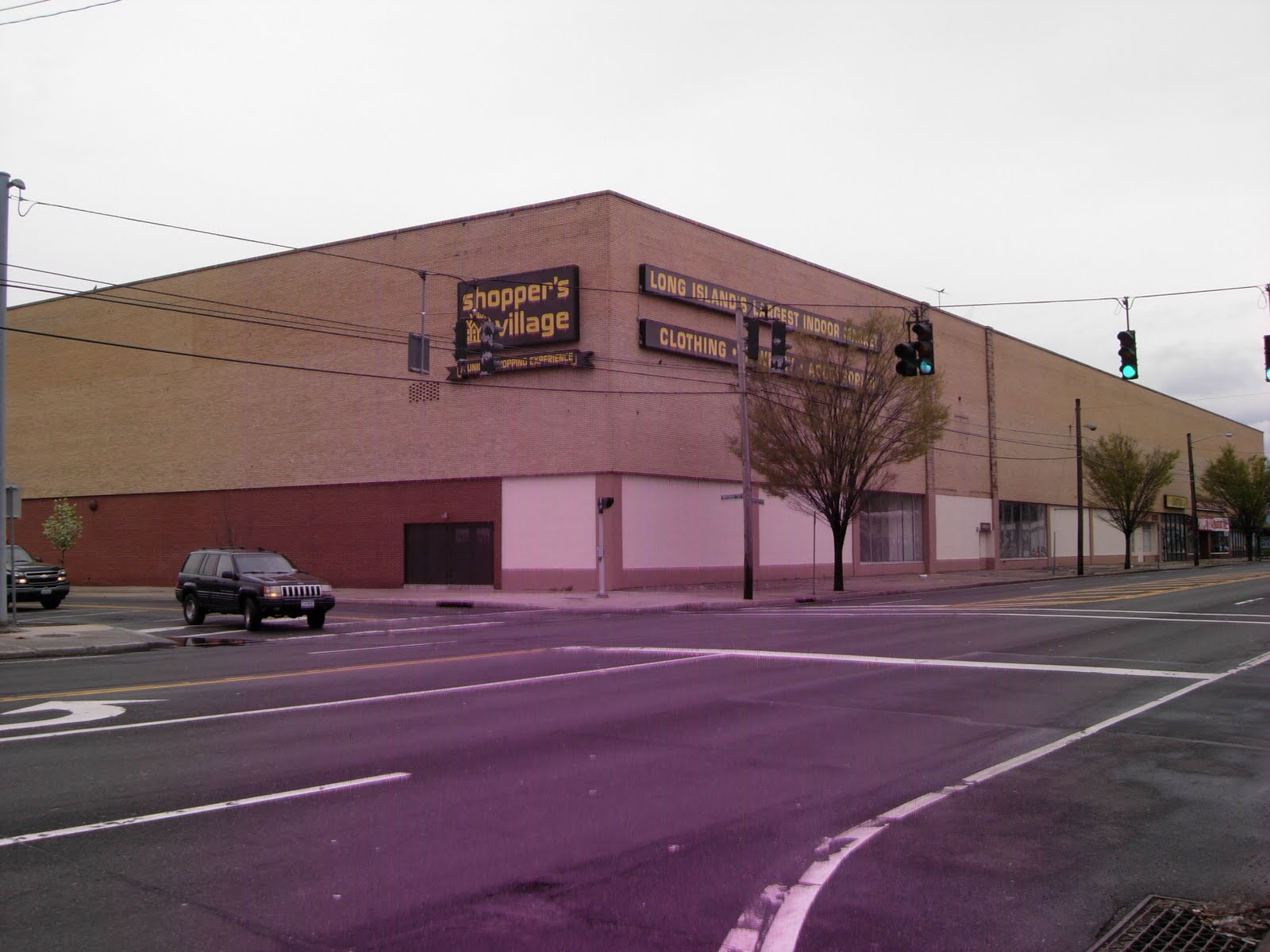
The recent “liquidation” of the National Wholesale Liquidators flagship store in West Hempstead and subsequent reopening (and reclosing) of Shopper’s Village gives us an opportunity to reflect on the history of a property that for over 50 years has housed our neighborhood’s largest retail establishment in one form or another.
We pick up the story in 1891, before which time the entire area was but a wooded and grassy meadow. The property was originally part of a
19 acre estate built by War of 1812 veteran Adrian V. Cortelyou, and later sold to Henry M. Onderdonk, editor of the Hempstead Inquirer. That September, LIRR president Austin Corbin started buying up hundreds of acres in West Hempstead, including the triangular property bounded by Hempstead Tpke., Westminster Blvd. and Hempstead Ave., instantly making him the neighborhood’s largest individual land owner
1. More than just purchasing land for a new rail line that would run from Valley Stream to Mineola (the remnant of which comprises the existing WH branch of the LIRR), Corbin envisioned developing a planned community to rival the style of Garden City
2. Corbin died unexpectedly in 1896 and his grand plan never materialized to the scale of his aspirations, leaving many large, vacant plots of land.
The tract remained undeveloped and in the hands of the LIRR, which for a time used the property as a grazing area for the horses of the Long Island Express Company (see
this post). Then in May 1941, a man named John “Ole” Olsen came on to the scene. Olsen and his partner Chic Johnson had struggled in the small-time Vaudeville circuit for 25 years until the debut of their hugely popular smash hit Broadway musical,
Hellzapoppin. By the time it ended its almost four-year run in 1941, Hellzapoppin became Broadway’s longest running musical and third longest running play of any kind
3. Olsen, a resident of Malverne, became a big celebrity and made a killing on his show, and now was confronted with two primary problems - finding a good investment for his new fortune and finding a good local shopping venue where his wife could spend it. His solution was to head up a syndicate to purchase twelve acres of land in West Hempstead and develop a business and shopping center on it. His ambitious plan called for a building to accommodate a department store such as Sears or Montgomery Ward, a 1,500 seat theater, a sports center with bowling alleys and an ice skating rink, a “Howard Johnson” type restaurant and other retail shops
4.
Disappointed West Hempsteaders who never got to see this development materialize can blame Emperor Hirohito for putting a hold on plans because in December of that year, a little incident at Pearl Harbor drew the US into WWII, effectively putting a stop to any major capital projects that didn’t have to do with the war effort. By the end of the decade Olsen’s project lost steam, though he did accomplish some minimal development not the least of which included a car wash he aptly named ‘Carzapoppin’
5. During this time, a professional PGA golfer named Art Stuhler also set up a driving range on the site to the delight of St. Thomas school children who would scavenge for golf balls along the fence on their way to and from school. In July 1952, Olsen sold most of his land to Samuel Leider, a developer who had just completed the Centre Island Shopping Center in the brand new settlement of Levittown. Leider planned on bringing in S. Klein on the Square as the anchor tenant of a new 200,000+ sq. ft. building
6. ‘Klein’s’ was a full-line discount retailer on Manhattan’s Union Square that started in 1906 and focused on selling bargain merchandise. Financial problems and disputes between shareholders delayed the project’s construction
7 until it was finally completed in 1955. While the building was not exactly a marvel of architecture, it did provide modern conveniences like elevators and escalators and, oh yes, plenty of parking. To understand the phenomenon of the property’s massive underused parking lot is to appreciate the whale sized vehicles driven by our mothers and grandmothers in the ‘50s, the Long Island housewife’s disaffection for parallel parking those vehicles (especially the ones with the fins), and the lack of requisite parking at existing local dept. stores like Arnold Constable in Hempstead.
For West Hemspteaders old enough to wax nostalgic about those days, it didn’t get much better than the summer of ’55 and the heyday of the baby boomer generation. Scores of new homes, schools, churches, and synagogues were transforming the neighborhood, the Brooklyn Dodgers & NY Yankees were headed to the World Series, ‘Rock Around the Clock’ by Bill Haley & His Comets was playing on the radio, and West Hempstead was getting its very own department store.
For Klein’s management, however, anticipation of the August 15th grand opening was probably cause for more anxiety than excitement, after the launch of their first branch store in Newark five years earlier had caused a potentially dangerous human stampede. Terrific hype leading up to that opening (the front section of the previous day’s Newark Star-Ledger contained 14 full page broadsides announcing deeply discounted goods) had backfired when over 150,000 bargain hunters showed up. The mob forced managers to close the doors every 10 minutes to allow the disbursement of shoppers while police were called in for crowd control. Learning from that mistake, Klein’s heralded the WH opening with an understated single page ad in Newsday
8. The plan worked, for although the 1,500 car parking lot was quickly filled (for the first and probably only time), the crowd was civil and orderly while shoppers sifted through racks of $1.39 skirts and 39¢ hosiery
9.
By 1974, major operating losses forced Klein’s to sell off the WH store to another discount retailer called EJ Korvette. Korvette’s didn’t last very long, however. Mismanagement and a slowing economy forced it into bankruptcy and by 1980 the WH store was closed. After that was the brief tenure of Woolco (Woolworth’s experiment in the discount box chain market), followed by an indoor flea market called Shopper’s Village. Many locals still fondly remember the old Shopper’s Village for its grab-bag bargains and colorful vendors known by the particular merchandise they plied such as “the Pickle Man” and “the Dollhouse Lady”. The flea market operated for over a decade until it closed in 1995, done in to some extent by the soaring utility rates of the ‘90s.
The closing of Shopper’s Village created an expansion opportunity for National Wholesale Liquidators, an up and coming, locally based discount retailer that offered a wide variety of closeout items. For over the past decade, the building housed not only its flagship store, but also its national headquarters.
Alas, the wheel of history continues to turn, as National Wholesale Liquidators filed for Chapter 11 last year, giving a chance for a second go-around for Shopper's Village . Unfortunately, though, once again the viability of Shopper’s Village was short lived, leaving us awaiting to find out what’s “in store” for property that for decades has been an integral part of West Hempstead’s business landscape.
[1] “Buying Farms” Brooklyn Eagle 19 Sept, 1891 2
[2] See “Improvements at Hempstead” Brooklyn Eagle 30 May, 1894 12.
[3] Stanley Green, Encyclopedia of the Musical Theatre (Da Capo Press, 1980) 184
[4] “Business Center Planned in Nassau” NYT 11 May 1941 RE1
[5] “Farm in Baldwin Sold for Housing” NYT 17 Apr 1954 21
[6] “Stores Planned on Site Bought From Ole Olsen” NYT 25 Jul 1952 32
[7] “Shopping Center Halted by Dispute” NYT 26 Nov 1953 55
[8] The ad was placed on page 9 of the Saturday edition of Newsday[9] “Klein Causes Jam at ‘Quiet Opening’” NYT 16 Aug 1955 34