Showing posts with label Munson. Show all posts

Friday, August 10, 2012

Empire State Diner


The photo above c. 1949 looks south across Hempstead Turnpike and shows the Empire State Diner, a West Hempstead landmark during the '40s '50s and '60s. The diner was owned and operated by a Cathedral Gardens resident named Charles Efthinion, along with his brother Phillip who lived in nearby Hempstead Gardens.  

The Efthinion Bros. ran the restaurant until 1963, whereafter they relocated down the road to the southwest corner of Hempstead Turnpike and Nassau Blvd (current location of a Sleepy's), and opened a restaurant called "The Country Gentleman".  That restaurant was built on a site that for years, dating back to the 19th century, was occupied by William Stringham's general store and was once the central location of the long-forgotten Hamlet of Munson. Below is a "now" shot of the old Empire State Diner location. 
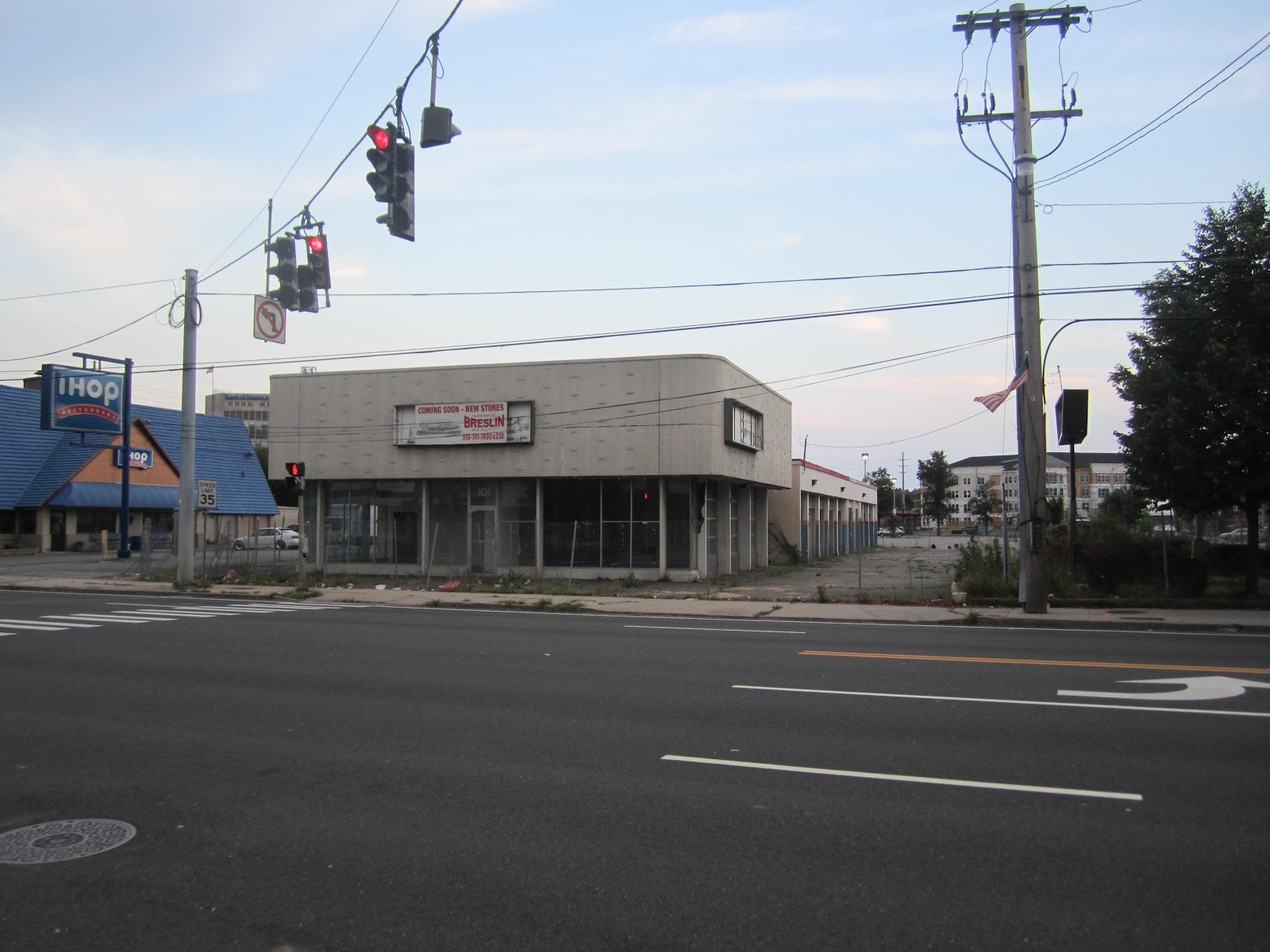


In 1964, the diner was demolished and in November of that year, ground was broken to build the first of many IHOPs on Long Island.  That restaurant continues to operate at the same location, nearly 50 years later, one of the few original businesses from that era.  (Below is an ad that appeared in the May 13, 1965 edition of Newsday).


The vacant building in the "now" shot was built in 1966 and represented S Klein's first foray into the automotive and tire business.  The building boasted 12 bays and the operators originally envisioned a capacity of servicing up to 280 cars per day.  What they did not envision was that S Klein wouldn't last another 10 years after that.

 The S Klein Tire & Auto Center became Korvette's Tire & Auto Center which then became Tires Incorporated.  This building may well be the record-setter for the duration of a vacant commercial building in West Hempstead.  (No, the temporary occupancy as the campaign headquarters of former Town Supervisor Greg Peterson's failed election bid for County Executive in 2005 does not count for filling the vacancy).

Thursday, April 1, 2010

Munson L.I., a Forgotten Hamlet

The photo of the magnificent estate at left comes from the May 5th, 1917 edition of the NY Sun announcing the sale of the home to Mr. & Mrs Wilford L. Wright, president of the Savage Arms Company. The seller was Harry Munson, who had lived in the home for over 20 years. The 20 acre property was located on the north side of Hempstead Turnpike between Nassau Blvd and Cherry Valley Ave, where the Compare Foods Shopping Center is now located, and extended all the way back to the Garden City border.

Harry Munson (pictured at left) was a decorated Civil War veteran who made a fortune in advertising in New York City. Some estimated that he had a 50% market share in Manhattan's billboard posting business. In 1896, he retired and purchased the home above in a tiny village then called Washington Square, centered around the corner of the Hempstead-Jamaica Plank road (Hempstead Tpke) and John St (Nassau Blvd). Upon moving out to Long Island, Washington Square then became known as Munson in honor of the area's newest resident. Despite the fact that Harry Munson was a successful businessman and decorated Civil War hero, it is surprising to consider that local residents were so eager to change the name to honor a newcomer. After all, with his purchase, Munson initially intended occupy his country seat only on a part time basis as a Summer retreat. Perhaps we can offer the following theory:

In 1892, Washington Square in Manhattan gained national recognition when a memorial arch was erected to celebrate the centennial of President George Washington's inauguration. The existing, permanent memorial arch was completed in 1895. This created too much confusion for tiny Washington Square, Long Island, and shortly thereafter locals began looking for a suitable replacement name for their village. When Munson came on to the scene and purchased the area's most prominent home and property, he was a natural candidate to be given the honor of the village's namesake.

In 1947, Wilford L. Wright died. Five years later the home was sold to the Ethical Cultural Society (later called the Ethical Humanist Society of Long Island), who then used the building as their headquarters until they built a new headquarters on Old Country Road in Garden City. The photo at left comes from the EHSLI website and shows the building as it looked in the 1950s. As a testament to the size of the home the Ethical Cultural Society converted the rooms of the house into a Platform room with a capacity of 100 people, a study, lounge, kitchen, office, caretaker's room and six Sunday School classrooms.


A survey of local newspapers such as the Hempstead Inquirer and the Hempstead Sentinel from the early 1900s shows that local news from Munson was covered much more extensively than other neighboring locales such as West Hempstead, Lakeview and Franklin Square. Munson had it's own hotel, a general store, a blacksmith, various other businesses and even its own baseball team. Over time though, Munson slowly lost its identity because it got crowded out by the expansion of West Hempstead from the east and Franklin Square from the west. Only an echo of Munson exists in the name of the Franklin Square & 'Munson' Fire Dept., and Munson Ave., south of Hempstead Turnpike, just east of Nassau Blvd. Below is a photo of the location of the Munson/ Wright home as it looks today.


Thursday, August 20, 2009

Old School District 17 Schoolhouse

The old schoolhouse of school district 17 was the first school in our neighborhood and is perhaps best known for the brief stint that a young Walt Whitman spent there as schoolmaster in 1840. Located at the south corner of Nassau Blvd and Dogwood Ave, the school served a large area west of Hempstead Village including all of current West Hempstead and Franklin Square until SD27 split off from it in 1911 and a schoolhouse was built at Chestnut St. A wonderful essay which can be found here, by Adelphi University professor Thomas Heffernan, reconstructs Walt Whitman's time spent at the school.

Back then, the neighborhood was called Trimming Square. How did the place get its name? One plausible theory is that the entire Hempstead Plains, roughly the area where Garden City is now located, was once a treeless common area used by residents of Hempstead for grazing their sheep and cattle. A spot just south of the plains along the Hempstead-Jamaica road was designated where residents could round up their sheep to be sheared, a place which thereafter became known as "Trimming Square". At some point in the mid 1800s Washington Square became the preferred name for the location. After that, in 1895 a NYC businessman and Civil War vet named Harry Munson moved out to the neighborhood and thereafter the place became known as Munson. More about Harry Munson will come in a future post.

Back to the old schoolhouse. While the exact date it was built is unclear, the school dates back no earlier than 1813 and no later than 1831. No earlier than 1813 because when the NY state legislature created school districts in 1812, the school was not enumerated among the 13 districts of Hempstead. And no later than 1831 because of the testimonial of one Ezekiel Frost, born in 1816, of having attended the school in Trimming Square as a child.

The aforementioned essay contains the photo below of the old school as it appeared in the 20th century. The photo comes via Dr. Paul van Wie, president of the Franklin Square Historical Society. Originally a one room schoolhouse, an addition was built around the year 1894. The schoolhouse was eventually replaced in the 1930s by the John Street School a little further north, John St. being the former name of Nassau Blvd.

The 1914 E. Belcher Hyde map gives us a hint that the entrance to the school faced Nassau Blvd., so the then shot was taken looking west. The now shot below comes from Google Maps and shows what the scene looks like today. No evidence remains of what used to stand at the corner of Dogwood Ave.

Friday, March 20, 2009

General Foods Arch

The photo below is a picture of an Arch that was erected by the General Foods Co. for the 1964-65 NY Worlds Fair in Flushing.

From what I could gather from the posted comments at the worldsfaircommunity.org forum (hat tip), the arch was one of eleven scattered about the grounds of the Worlds Fair and in essence served as an advertisement for the General Foods Company as well as an information kiosk and rendezvous destination for fair goers. After the fair, General Foods sold off and/or scrapped the kiosks and the good old Worlds Fair enthusiasts at the linked website above were able to track down five of them that still exist in various parts of the country.

One of the archs ended up at the entrance to the Cherry Valley Center, a.k.a. the Pathmark shopping ctr, and remains WH's best specimen of the type of googie architecture that was popularized in the '50 and '60s.

I like to think of it as West Hempstead's own Gateway Arch, beckoning homesteaders' westward migration into the wild wild west (Elmont?) and the hinterland beyond (NYC?) - OK, maybe the comparison's going too far.

I'd love to find out more about this landmark if anyone has more info about it (e.g. when it was put in, who bought it, etc.)